Iptv Live Sports
IPTV in Iraq and the Middle East: How Sports Fans Finally Get Every Live Match
If you live in Baghdad, Erbil, Basra, or anywhere across the Gulf, you already know the ritual: the match kicks off at 22:00, the satellite signal freezes at the worst possible moment, and your group chat erupts in frustration while the neighbours' feed is ten seconds ahead. For a region that lives and breathes football, that is simply not good enough anymore. The way people watch live sports in Iraq and the wider Middle East is changing fast — and IPTV sits right at the centre of that shift. Instead of paying for a dish, a receiver, and a subscription package you barely use, a modern sports-focused IPTV service delivers thousands of channels over your existing internet connection, on the device you already own.
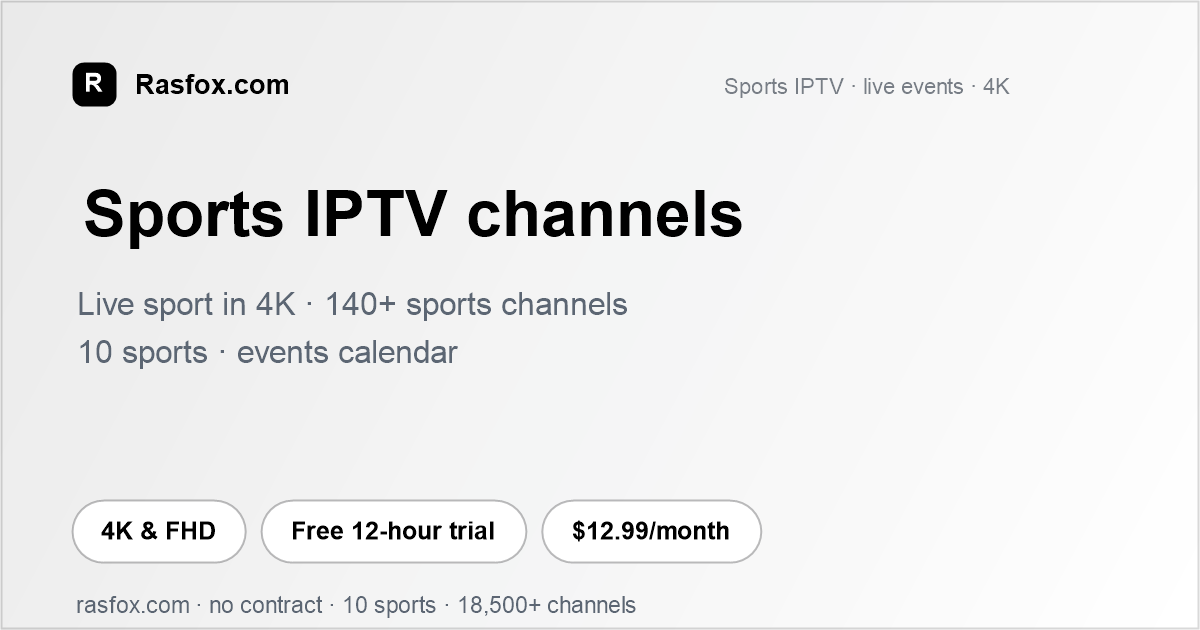
This guide breaks down what IPTV actually is, why sports fans in the Middle East are migrating to it in record numbers, which channels and competitions matter most, what hardware you need, and how to tell a safe, legal-friendly provider from the risky ones. By the end, you will know exactly how to watch every Champions League night, every Premier League weekend, and every major tournament without missing a single goal.
What Is IPTV — and Why Does It Change Everything for Live Sports?
IPTV stands for Internet Protocol Television. Instead of receiving a broadcast signal through a satellite dish or a coaxial cable, your channels arrive as data packets over the same internet connection you use for Netflix, YouTube, and WhatsApp. That sounds technical, but the practical difference is enormous.
A traditional satellite setup in Iraq or the Gulf locks you into a fixed position: you need the dish, the LNB, the receiver, an installer, and a clear line of sight. Move apartments, and you start again. Add a second TV in the bedroom, and you pay for a second receiver. IPTV erases all of that.
- No dish, no installer, no roof access. If your internet works, your TV works.
- Instant channel switching — no scanning, no waiting, no "signal lost" messages during a penalty shootout.
- Full HD, 4K and 50FPS streams for the big matches, so you can actually see the ball.
- Multi-device freedom — phone, tablet, smart TV, laptop, and Android box all at once.
- Catch-up and VOD libraries, so a late kickoff never means missing the game.
The trade-off is that IPTV quality depends entirely on the provider. A cheap, overcrowded server will buffer during the exact minute everyone in the country is watching. A properly built one will not. That single difference is why provider choice matters more than anything else in this category.
Sports Is Where IPTV Wins Completely
Streaming services like Netflix or Shahid are built for films and series — content you watch on your own schedule. Live sport is the opposite: it happens once, at a fixed time, and millions of people want it simultaneously. That is precisely the scenario IPTV was made for, provided the infrastructure behind it is designed for peak load.
This is where RasFox positions itself differently from general-purpose providers. Its network is built around live sport first, with sports channels treated as the priority during peak kickoff windows rather than an afterthought. For a football-obsessed region, that design decision matters more than any marketing claim.
How IPTV Fits Into Modern Digital Life in the Middle East
The Middle East has one of the youngest, most mobile-first populations on earth. Households here do not watch television the way they did fifteen years ago. The TV is now one screen among five, and the family schedule revolves around work, university, travel, and — during the season — football.
That lifestyle shift is exactly why IPTV has moved from a niche tech curiosity to a mainstream household utility. Consider a typical evening in an Iraqi home during the season:
- Dad is in the living room watching the Premier League on the main TV.
- Mum is in the kitchen following a series on her tablet while cooking.
- The eldest son is in his room watching a Champions League replay on his phone.
- The youngest is streaming cartoons on a smart TV in the bedroom.
With satellite, that household needs multiple receivers and multiple subscriptions. With a modern IPTV plan — RasFox includes 2 simultaneous screens as standard — it is simply one connection doing four jobs.
The Diaspora Angle: Watching Home From Abroad
There is another audience that IPTV serves exceptionally well: expats. Iraqis working in the Gulf, Gulf nationals studying in Europe, and Latin American and Lusophone families scattered across the world all share the same problem — home leagues are almost impossible to find on local cable.
This is where RasFox's roots are genuinely unusual. The project grew out of the tradition of Radio Malena 89.1 FM in Buenos Aires — broadcasting from Venezuela 370, a station steeped in tango and Argentine culture for decades. That heritage in Latin and Lusophone broadcasting evolved naturally into IPTV distribution, and it is why the platform now serves Portuguese- and Spanish-speaking audiences worldwide alongside its Middle East and global coverage. It is not a generic reseller; it is a broadcaster that moved from radio to internet protocol.
One Subscription, Many Worlds
For a mixed household, that matters. A father in Basra might want beIN Sports and the AFC Champions League. His Brazilian colleague might want Globo, SporTV and Premiere. A Portuguese neighbour might want Sport TV 1–6. RasFox carries 12,000+ live channels and 40,000+ on-demand titles, which means nobody in the building has to compromise. You can explore the full offering at RasFox.com.
Deep Dive: The IPTV Landscape in Iraq and the Middle East
Internet infrastructure across the region has improved dramatically over the past five to seven years. Fibre rollouts in Baghdad, Erbil, Basra, and Najaf, plus increasingly competitive 4G and 5G packages, mean that a 25–50 Mbps connection is now entirely normal for a household. That is more than enough for a stable 4K IPTV stream, which typically requires 25 Mbps per screen.
At the same time, the regional sports rights landscape has become complicated and expensive. Major competitions are split across multiple broadcasters, and following a full season across all of them through traditional subscriptions is costly. This is the gap IPTV fills.
Channels That Matter to Fans in the Region
RasFox's sports tier is built around the competitions the Middle East actually cares about, and it adapts its regional packages to the market:
- Middle East & MENA: beIN Sports (all regional feeds), Al Kass, AD Sports, Dubai Sports, Iraqia Sports.
- Africa: SuperSport, Sport TV Africa, ESPN Africa.
- Brazil: Globo, SporTV, Premiere, ESPN Brasil, BandSports, Combate, TNT Sports BR.
- Portugal: Sport TV 1–6, Eleven Sports, Benfica TV, Porto Canal, DAZN Portugal, Eurosport.
- Argentina & Latin America: TyC Sports, ESPN Premium, TNT Sports Argentina, Fox Sports, DirecTV Sports.
- Worldwide: ESPN, DAZN, Fox Sports, Sky Sports, beIN Sports, Eurosport.
In practical terms, that covers the full season calendar: the Champions League, the Premier League, La Liga, Serie A, the AFC Champions League, the Copa Libertadores, the Brasileirão, the Liga Portugal, the Liga Argentina, plus Formula 1, UFC, and major boxing nights.
Why Sports-First Infrastructure Beats Generic IPTV
Anyone can write "12,000 channels" on a website. The real question is what happens at 21:45 on a Wednesday when half a million people log in for a Champions League match.
RasFox handles this in three ways. First, sports feeds are hosted on dedicated high-bandwidth nodes rather than being pooled with general entertainment. Second, streams are delivered in 4K at 50FPS where the source permits, which gives football the smooth motion it needs — 25FPS streams produce that blurred, "ghosting" look behind a fast-moving ball. Third, the service is engineered for zero buffering under normal conditions, which is the single thing IPTV customers complain about most.
These are not abstract features. They are the difference between watching a match and watching a slideshow.
Hardware and Setup: What You Actually Need
One of the most attractive things about IPTV is how little equipment it requires. If you already own a TV and an internet connection, you are 90% of the way there.
The Minimum Setup
- Internet: 15–25 Mbps for HD, 25–50 Mbps for 4K. A wired Ethernet connection beats Wi-Fi every time for live sport.
- A device: Smart TV (Samsung, LG, Android TV), Fire Stick, Android Box, Apple TV, MAG box, or even a laptop.
- A player app: Most providers supply the recommended app or portal details after signup.
The Ideal Setup for a Football Household
- A dedicated Android TV box connected by Ethernet to the router.
- A 50 Mbps+ fibre line so multiple screens can run simultaneously.
- An EPG (electronic programme guide) configured so you can see kickoff times at a glance.
- A bookmark or favourites list for your top sports channels, so you are not scrolling through thousands of options at kickoff.
If you are setting up for the first time, it helps to test before committing. A 24-hour free trial lets you check stream quality on your own connection, on your own device, during a live match — which is the only test that actually matters.
Before you buy anything, it is also worth checking the provider's reliability reputation and channel list directly rather than relying on screenshots. You can review the current lineup and device compatibility at the RasFox IPTV platform.
Legal vs. Illegal IPTV: What You Need to Know
This is the part most guides skip, and it is the part that matters most. IPTV as a technology is completely legal. It is used by telecom operators, national broadcasters, and major streaming platforms worldwide. What varies is how the content is licensed.
Three Categories You Should Understand
| Type | How It Works | Risk Level |
|---|---|---|
| Licensed / operator IPTV | Telecoms and official broadcasters distributing their own licensed content. | None |
| Aggregator services | Third-party platforms bundling channels; licensing varies by region and package. | Varies — check terms |
| Pirate / grey-market IPTV | Resold streams with no rights, often hosted on unstable servers. | High — legal, security and quality risk |
The practical warning signs of a grey-market provider are consistent across the industry:
- Prices that are implausibly low — a full year for the cost of a coffee.
- No company information, no terms of service, no support channel.
- Payment only via untraceable methods.
- Constant buffer, channels disappearing mid-season, and servers going down during big matches.
Your protection is simple: use a provider with a verifiable identity, real customer support, transparent terms, and a trial period. RasFox, for example, offers a 24-hour free trial, multilingual support including Portuguese and Spanish, and no long-term contract — so you are never locked in and can judge the service on evidence rather than promises. You can start here: RasFox IPTV official site.
Security Basics Worth Following
- Never enter payment details on a site with no visible business identity.
- Avoid sideloading unknown APK files from unofficial sources.
- Use a unique password for your IPTV account.
- Prefer providers that support standard, reputable payment methods.
Conclusion: The Match Starts in Ten Minutes — Will You Be Watching?
Football in Iraq and the Middle East is not a hobby; it is a shared language. The problem has never been a lack of passion — it has been access. Satellite dishes freeze, subscriptions fragment into five different bills, and the biggest matches always seem to be on the channel you do not have.
IPTV solves that. One connection. One plan. 12,000+ channels, 40,000+ on-demand titles, 4K 50FPS sports streams, two simultaneous screens, no buffering, and no contract. Backed by a provider with genuine broadcasting roots — from Radio Malena 89.1 FM in Buenos Aires to a global IPTV network serving Lusophone, Latino, Middle Eastern, and international audiences alike.
If you have been putting off the switch, the 24-hour free trial is the easiest way to settle the question. Test it during a live match, on your own internet, on your own screen. You will know within twenty minutes. Get started with RasFox IPTV today — and never miss a kickoff again.
Frequently Asked Questions
Is IPTV legal in Iraq and the Middle East?
IPTV technology itself is fully legal. What matters is licensing. Services that distribute content without rights operate in a grey area and carry legal and security risks. Always choose a provider with transparent terms, verifiable business details, and proper customer support.
How much internet speed do I need for IPTV in 4K?
Around 25 Mbps per 4K stream and 10–15 Mbps for Full HD. For a household running two screens at once, a 50 Mbps fibre connection is comfortable. A wired Ethernet connection is strongly recommended over Wi-Fi for live sport.
Can I watch Champions League and Premier League matches with RasFox?
Yes. The sports tier covers the Champions League, Premier League, La Liga, Serie A, the AFC Champions League, Copa Libertadores, Brasileirão, Liga Portugal, Liga Argentina, plus Formula 1, UFC, and major boxing events through channels including beIN Sports, Sky Sports, ESPN, DAZN, and SuperSport.
How many devices can I use at the same time?
RasFox plans include 2 simultaneous screens as standard, which is enough for the typical household. You can install the service on multiple devices — smart TV, phone, tablet, Android box — but only two can stream at once on a standard plan.
Is there a free trial before I subscribe?
Yes. RasFox offers a 24-hour free trial so you can evaluate stream stability, picture quality, and channel availability on your own connection before paying anything. There is no long-term contract, so you can cancel whenever you choose.
Does RasFox support Portuguese- and Spanish-speaking customers?
Yes. The platform originated from Radio Malena 89.1 FM in Buenos Aires and maintains strong Lusophone and Latino coverage, including Brazilian, Portuguese, and Argentine sports channels, with customer support available in Portuguese and Spanish alongside English.